Showing posts with label Frederick Vincent Brooks. Show all posts

Saturday, 21 February 2015

Curious Water-Colour from Canada


The beauty of the internet and the accessibility to information it has created was demonstrated last year when we were contacted by a lady from Canada. A friend of hers had acquired a water-colour entitled 'The Curio-Hunters'. It shows two orthodox priests admiring what looks like a holy-water bottle.   


On the back of the picture is pasted a note:
"27 Hornsey Rise Gardens, N

My dear May,
I am sending this little water-color with best wishes for your birth-day.

The old gentlemen are “curio-hunters” in another part of the world, in the same way as your own father is, in this England of our’s.

With love from Mrs. Brooks and myself.

Yours faithfully,
F.V.B.

Oct. 20th, 1901"


We have managed to find out nothing more about the painting or who May was but at least the modern owner of the piece knows a little something of the giver.


Friday, 12 June 2009

What's my name?

In the autobiography, frederick writes:

"The records of the Parish Church, St. Ann’s, Soho, bear witness that a little later the label “Frederick Vincent” was attached to me in solemn form, and certain promises were made on my behalf in which Miss Castell, a girl friend of my mother, took part: for a long time I thought that her name had been added to the others.

At school I was always known as “F.V.C. Brooks”, which my schoolfellows used to suggest savoured of a redundance not wanting in other directions : but on going to the Church Registry many years after I found that the extra name was a myth."


The extent of our author's mistaken belief regarding his own name has been discovered on obtaining a copy of his marriage certificate. Just how long the erroneous middle name persists after Frederick's school years, he fails to mention but long enough for him to spell it out for eternity on his wedding day.

Edit:
In fact, Fred's baptism does record Castell as a middle name.

Wednesday, 17 September 2008

Schooling Sexologists

Henry Havelock EllisIt is always gratifying when a description or name mentioned by our author can be corroborated with the account of another. Such an example is given by Henry Havelock Ellis. In his colourful and controversial adult life he spent time as a sexologist, psychologist, philosopher, critic, author and editor, teacher, a man of medicine, long-time virgin and husband of a lesbian. At least some of his childhood time at the school near Tooting Station must responsible for influencing published ideas.

Frederick attended The Poplars, Mitcham from the age of 8 in 1856. It is surprising that, 16 years later, Havelock Ellis did the same under the notable Albert Grover. This teacher had at least 25 years of experience to develop his eccentric method and although Frederick is largely complementary, Havelock Ellis is exasperated by his poetry and it is a fellow teacher that inspires him on his path within philosophy and medicine.

Havelock describes Albert Grover as

...an oddity, a tall middle-aged man, looking much older than his years, with a long grey beard, a bald head and a blind eye. He had some resemblance to Darwin but he cherished much contempt for that great man's doctrines...

Havelock Ellis developed his interest in literature, reading Keats, Shelley, Carlyle and Elliot, the kind of people Frederick's grandfather would have had dealings with. As a man, he too mixed with the men of ideas and reformers of his age.


Sources:
Havelock Ellis
Australian Dictionary of Biography Online Edition Henry Havelock Ellis
Havelock Ellis, Henry et al. (1967) My Life
Brome, Vincent (1979) Havelock Ellis, Philosopher of Sex: A Biography

Thursday, 11 September 2008

Frederick's Figge's Marsh Military Mates

Following his banishment to boarding school, Frederick was fortunate to come to know the brother's McRae, MacRae or M'Rae.

The 1861 census lists both brothers, their widowed mother and teacher Albert Grover boarding at the schoolhouse in Mitcham, Surrey. Archibald is roughly Frederick's age and Henry around three years younger. The boys' inevitable journey into the military would have made their Surgeon father, James and their mother, Emma Caroline proud.

My understanding of army rank and regiment is sketchy but first record found of Archibald attests that he became an Ensign on 11th January 1867 at the age of 19. His career starts with the 36th (The Herefordshire) Regt. Of Foot. Quickly he rises to Lieutenant by 1871 as part of the Punjab Frontier Force. Wing Subaltern, Quarter Master, Wing Officer, Adjutant and Wing Commander by 1883, he served in the '22nd (Punjab) Bengal Native Infantry (late 11th Punjab Infantry)'. The 22nd had their headquarters at Peshawur. We can speculate that Archibald felt somewhat at home in this part of the world as Emma's children were born and christened in India, Dr McRae had belonged to the Bengal Medical Service.

Archibald eventually becomes a Major but it is Henry Napier McRae CBE who becomes the subject of many a story of war gallantry and heroics...

Sources:
The New Army Lists of 1867, 1874, 1875, 1878 and 1883
The Church of Jesus Christ of Latter-day Saints Family Search Index
Richard Cannon Historical record of the Thirty-sixth, or the Herefordshire regiment of foot

Henry Napier McRae

Henry Napier M'RaeYounger brother of Archibald Spiers M'Rae, Henry, appears to have surpassed him in terms of fame, through the saving of lives, winning medals and contributing to favourable outcomes in famous battles.

Linley and Jim Hooper neatly summarise Henry's military career and further relations. An extract is below:

Henry Napier MacRae CBE
b. 27 January 1851, d. 18 January 1915

Henry Napier MacRae CBE was born on 27 January 1851 at Ferozepore/Firozpur, Lahore, Punjab, India. He was the son of Surgeon Major James McRae (b. 1803 Edinburgh), Indian Army. He was educated privately.

Henry Napier MacRae CBE appeared on the 1861 census at 'The Poplars', Figs Marsh, Mitcham, Surrey. Archibald S McRae, 14, born Benares, India & Henry N McRae, 10, born Ferzapor, scholars, were boarders with Albert Grover, schoolmaster.

Henry Napier MacRae CBE appeared on the 1871 census at Royal Engineers & Royal Engineer Dept, Aldershot, Hampshire. Henry Napier McRae, visitor, unmarried, 20, Ensign 8th Regt Infantry, born India.

He served in the Indian Army from 1871 to 1914. He received his first commission in the 8th Foot on 25 March 1871; Lieutenant 28 October 1871; Bengal Staff Corps 15 August 1874 with the 45th Bengal Infantry; Captain 25 March 1883; Major 7 December 1888; Lt Col 25 March 1897; Commandant of 45th Regt 19 April 1899; CB 20 May 1898. Served in Afghanistan 1787-80, North West Frontier 1884, Hazara 1888, North West Frontier 1897-8 (dispatches twice, medal with two clasps, CB); ADC to Queen Victoria and Edward VII; North West Frontier 1901-2 (despatches).


silver medalFrederick neglects to tell us of this in favour of fond memory concerning Archibald who was nearer his age. It is out of character for Frederick's pride not to make use of such association and so it is left to us and others including Winston Churchill to document these daring escapades. The Strand magazine documents the gripping account that persuaded The Royal Humane Society to provide the silver medal:

Silver medal textFollow the links for some more smashing pictures of Henry at the Siege of Malakand and Churchill's account, himself a second Lieutenant in the relief force.

Sources:
The Strand Magazine, Volume V, Issue 28, April 1893, An Illustrated Monthly The Medal of the Royal Humane Society
Jim & Linley's family pages

Friday, 29 August 2008

York Regatta

Another visit from the parents and another surprise from Grandad's attic.


Object: Silver cup.
Inscription: York Regatta, 1874, Won by F. Vincent Brooks

Frederick's associations with the old West London Rowing club are well known and are documented in the posts below. Unknown until now have been his exploits further a field. The river Ouse still sports a York City Rowing Club with their own regatta but whether this is the same historic event we do not know.

If you have any information please let us know using the comments facility below.

Saturday, 5 July 2008

Obituary from Times of Old

THE DRAWING OFFICE MATERIAL MANUFACTURERES’ & DEALERS ASSOCIATION

26/27 Farringdon Street,
London. E.C.4

27th September, 1921.
Dear Sirs,

I have pleasure in quoting a copy of the Obituary Notice which appeared in “The Times” on the 11th August, which will be of interest to you.

Yours faithfully,
ALFRED W. FOSTER,
Secretary.

A Master Lithographer.

A correspondent writes:-
Frederick Vincent Brooks, who died on Sunday, was the hereditary head of the old lithographic firm of Vincent Brooks, Day & Son Ltd, and a leading authority on all the subjects connected with lithography and sun-copying, on which matter he wrote the articles in the latest edition of “The Encyclopaedia Britannica.” He was also chairman of the G.W. Bacon & Co, Ltd., Map Publishers, official printer to the Senefelder Club, and was a personal friend of Charles Dickens.

Born to a Chartist father 72 years ago, Brooks was educated at Bishops Stortford, where he became personally known to Cecil Rhodes. He obtained a scholarship for Sidney Sussex College, Cambridge, but was called early to business. As a young man he distinguished himself on the river. For years he was the popular captain of the old West London Rowing Club, and became well know as “Daddy” Brooks. An excellent swimmer and a good boxer, he was also much more than an average amateur actor. Succeeding his father early as head of the business, he reproduced the first VANITY FAIR cartoon for Sir Gibson Bowles in 1869 – that of Benjamin Disraeli – and continued his connection with that journal almost without break until the end of its cartoon series. He was not only a master-craftsman, but a real artist in his own line, as may be judged generally by the work of the firm ever since it won the gold medal at the Great Exhibition of 1862 for a reproduction of Mulready’s picture, “The Wedding Garment.” He was also a very active Churchman. Well known and greatly respected as he was for his integrity and quick grasp of detail, he was in great demand as an arbitrator in business disputes. Brooks was a very kind-hearted and unselfish man, and was regarded with affection by his employees. Probably his last kindly action was to arrange for a service to be held at Holy Trinity Church, Kingsway, (close to his company’s works in Parker Street), to-day, at 12.30 before the funeral at the Wandsworth Cemetery, for the convenience of all the members of the staff.

Two sons are left to carry on the business after the hereditary manner. Both are ex-soldiers, and one of them, Captain W. Vincent Brooks, who gained the Military Cross, was wounded and taken prisoner by the Germans in May 1916.

Thursday, 24 April 2008

Rowing, Sculling and Am-dram

Frederick Vincent Brooks intriguingly entitles chapter 11 of his autobiography 'Theatrical memories'. Sadly we do not have this entry and cannot shed light on whether a humble 'first dramatic venture', on an occasion of the West London Rowing Club, led to further board-treading by our author.

The occasion referred to is documented in a programme we have found and records an address penned and presented by Frederick at St. George’s Hall, Langham Place, Regent Street. This venue originally opened as a concert hall for the New Philharmonic Society on April the 24th 1867 and in 1878 was being leased to amateurs for theatre productions.

F.V Brooks was for many years Captain of the West London Rowing Club and as the column in Vanity Fair attests, helped win the Thames Cup at Henley in 1876.

Dickens Dictionary of the Thames states that "Wandsworth is the head-quarters of the West London, a club which has the credit of having originated many years ago the athletic sports which are now so interesting a feature in London life."

Birley confirms that such rowing clubs popularised out of season activities such as the boxing, high jump and even the tug-of-war to maintain their competitors fitness and raise funds.

Dickens continues that "West London Rowing Club, founded in 1856, and consequently one of the oldest clubs on the river. Election by ballot of members, one black ball in five excludes. Entrance fee, £1 1s. Subscription £2 2s. for active, £1 1s. for non-active members. Members are permitted to take up life membership on certain conditions. Colours, scarlet and white stripes. Boat-house, Putney."

Programme of the Amateur Dramatic Entertainment, given at St. George’s Hall, Langham Place, by the West London Rowing Club, Saturday Evening, March 23rd 1878

An Address written and delivered by F.V. Brooks, (Captain W.L.R.C.) on the occasion of the West London Rowing Club

“ Brief words while actions wait are well,
The prompter’s hand is now upon the bell.”
And yet I must, although I gain your censure,
Just speak of this, our First Dramatic venture.
An old friend said ; who, it matters not,
Let’s show the world how many friends we’ve got.
Agreed ! Agreed ! ! Let us not lose a day,
But you, of course, must show to us the way.
Boxing ! Fencing ! ! Bayonet and Sabre ! ! !
Or “ Tug of War,” to show how we could labour
At pulling guns in front of hostile forces,
If England’s army should be short of horses.
No! there are competitions without end,
And competitions, Ladies can’t attend.
Ah ! That’s your weakness ; Well, you may laugh,
But of all our friends, they form the better half,
Who never fail to cheer us with their faces,
Whene’er a steamboat follows with our races.

This is such a theatre-going age,
For one short night we’ll try to walk the stage.
What shall we play ? Gilbert ? Farnie ? Reece ?
No ; we’ve a Member who has writ a piece.
This we can have, if we’ll but engage
To put it fairly on the stage.
Whose can it be ? Are you bewitched of Nemesis ?
A Comedy Drama is really Dilley-ightful.
Now, there’s the name, and here my mystery ends,
May “ Auld Acquaintance” bring to us new friends.
As to our Company, who shall create the parts ?
We’ve willing heads, I know we’ve willing hearts ;
Now flushed with pleasure, now pale with fright,
Just our Club colours, alternate Red and White.
We’ve Macklin and Hall, Simpson, yes and Strong ;
They’ll ply their sculls, and push the boat along ;
And should they meet with over much resistance,
We’ve other friends who’ll come to their assistance.
West Londoners have never yet been craven,
And should they hap’ly reach the looked of haven ;
Then shall this night, recalled o’er and o’er
“ In memory’s sweet, but brief encore.”
Bring back to us, though endless seasons run,
Your hearty, welcome plaudit, of Well Done !


Sources:
www.arthurlloyd.co.uk St. Georges Hall, Langham Place, Regent Street, London
The Rowers of Vanity Fair/Brooks FV
Dickens Dictionary of the London/the Thames (1871 & 1881)
Birley, D (1993) Sport and the making of Britain

Tuesday, 25 March 2008

The Duke of Wellington

dukeThe 'Iron Duke' believed in strong government and his opposition to parliamentary reform earned him his metallic title for reasons of a more domestic than constitutional nature; his unpopularity forced him to beef up security at Apsley House against the window-smashers. Despite this, his passing drew the crowds and the spectacle of a lavish state funeral had enormous repercussions on the arts, journalism and everyday consciousness of the general public. Although the irresponsible nature of Frederick's baby-sitting had arguably profounder impact on the boy who had not observed the procession himself, an account of the time would not be fitting without a mention of this occasion.

Frederick begins his autobiography with mention of his grandfather's return at the Waterloo celebrations and his subsequent agitation with regard to Arthur Wellesley. Scarcely had the Duke been 'stopped' in the 1820s, when, in the second chapter, his parents attend his funeral on Thursday November 18th 1852.

It is worth noting that the Duke had died on the 14th September. We can speculate on the reason for the delay in his interment. It may be that the preparation required for the ceremony, coupled with a macabre level of Victorian superstitious fear of burying a living icon meant that it was not until two months later, that Wellington was finally laid to rest.
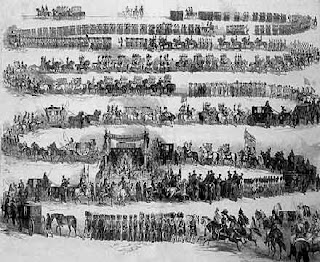
processionFor a taste of the experience Frederick's parents may have had, we can quote the New York Times, which followed the procession from Constitution Hill, Piccadilly, St. James's Street, Pall Mall, Cockspur Street, Charing Cross, Trafalgar Square to the Strand towards Fleet Street, Ludgate Hill and St. Paul's.

"Amid the rise, and perhaps the fall, of empires, amid “fear of change perplexing the nations,” amid earthquake and flood, a trembling earth and a weeping sky, Wellington was conveyed..."

"Most of the houses along the line of the route exhibited half-mast flags or other symptoms of mourning. Temple Bar was completely enveloped in drapery of black silken velvet, with fringe of silver, and turned aside at the top so as to display an under lining of cloth of gold."

Despite Frederick's fleeting reference to the funeral and his grandfather's apparent preference to rock cakes and drinking, we should not underestimate the occasion for a significant proportion of Londoners and those from further a field.

W. Liebknecht neatly illustrates the frenzy of the procession as observed and as joined from the opposite side of Temple Bar to that of Frederick's parents.

"I had made my plan. We had no money to hire seats at a window, or on a stand. The funeral procession was to pass along the Strand, parallel with the Thames. We must get into one of the streets entering the Strand from the north, and running towards the river.

Holding one little girl by each hand, our pockets filled with provender I steered towards the coign of vantage which I had chosen, just by Temple Bar – the old City gates that divided Westminister from the City. The streets from earliest morning had been unusually animated, and were thronged with people. The procession, however, having to pass through many quarters of the giant town the millions of sight-seers divided up, and without any crush, we reached the chosen places. It was just what we wanted. I stood on some steps, the two little ones clasping one another, and each holding me by the hand, stood on a higher step. Hush! A movement in the sea of people; a distant, growing roar, like the roaring of the ocean, drawing nearer and nearer! An “Ah!” from thousands upon thousands of throats! The procession is there, and, from our position, we can see it as beautifully as if we were at the theatre. The children are delighted. No crush. All my fears are gone.

A long, long time. The golden procession wends its way with the gorgeous catafalue that is taking the “Conqueror of Napoleon” to his tomb, One new sight after the other until nothing more came. The last gold-laced rider has gone.
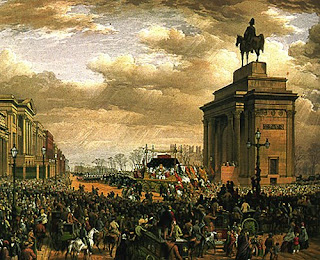
louis haghe funeralAnd now suddenly a rush – a rush forward of the mass piled up behind us. Everyone wants to follow the “procession”. I struggle with all my might to protect the children so that the stream may pass without hurting them. In vain. Against the elemental force of the masses no single human force can stand. It was as easy for a small fragile boat, after a hard winter, to resist an icefloe. I must give way, and, pressing the children tightly to me, I try to get out of the main street. I seem to be succeeding, and I breathe again, when suddenly from the right a new and more mighty wave of people bears in upon us; we are thrown into the Strand, the thousands and hundreds of thousands who have gathered into this street-artery want to hurry after the procession in order to see the sight once again. I set my teeth, try to lift the children on to my shoulders, but am too hemmed in. I convulsively seize the children’s arms; the vortex carries us away, and I suddenly feel a force pressing between me and the children. I grasp their wrists in either hand, but the force that has pushed its way between me and the children still presses forward like a wedge – the children are torn from me, resistance is hopeless. I must let them, go, or I shall break their arms. It was a hideous moment."


"...the funeral procession, comprised of more than ten thousand marchers, encompassed central London, enjoying an audience numbering more than one and a half million people. Queen Victoria and virtually every major and minor national figure in politics or the arts viewed either the procession or the ceremony at St. Paul’s."

Sources:
Bloy, M Arthur Wellesley, first Duke of Wellington (1769-1852)
December 3, 1852 New York Times The Wellington Funeral
March 1895 W. Liebknecht A Bad Quarter of an Hour translated by Eleanor Marx Aveling
Illustrated London News November 20th 1852 The Duke's Funeral
Pearsall C.D.J (1999) Burying the duke: Victorian mourning and the funeral of the Duke of Wellington Victorian Literature and Culture 27: 365-393 Cambridge University Press

Sunday, 2 December 2007

Looking to Learn about Lithography?

Want to know a little more about this 'lithography' thing that you keep reading about on this site? Nowadays the internet is an amazing source of information on just about any subject you can imagine. Just ten years ago we would have had to spend much time visiting libraries or seaching through archives. One of the many useful sources may have been an encyclopedia, none more well-known than the Encyclopedia Britannica. If we had followed this course, and happened upon the 1911 edition, we would have discovered an entry on Lithography written by none other than Frederick himself which you can read here. The 'LoveToKnow' site we have linked to states that many consider "the best encyclopedia ever written:[to be] the eleventh edition of the Encyclopaedia Britannica, first published in 1911. At a time when many encyclopedias have capsulated and condensed important knowledge, the 11th edition is generally much more in-depth and thorough on its topics.

It is not uncommon for its entries to be 5 to 10 times the length of other encyclopedias. As a research tool, this 11th edition is unparallelled - even today.
The Eleventh Edition filled 29 volumes and contains over 44 million words. It contains over 40,000 articles written by over 1,500 authors within their various fields of expertise. What was particularly remarkable was that many of the entries were written by the most famous people of the age. As such, it was considered to represent the sum of human knowledge at the beginning of the 20th Century."


A handwritten copy of the entry (see picture) was also found amongst Frederick's documents. At first we thought these papers might be a speech or draft of a journal article. Finding the 1911 Encyclopedia Britannica online, as we had during many internet searches, we noticed the tell-tale F.V.B. signature and put two and two together. The online text matches the hand script which Frederick wrote in 1907.

Friday, 30 November 2007

From the Cradle...

gravestone Vincent BrooksFrom reading the obituary in the British & Colonial Printer Circular, we knew that Vincent Brooks was laid to rest in Wandsworth Cemetery. His funeral, four days after his death, took place on October 3rd 1885.
Working in Selhurst and finishing early on a Friday I decided to track down his final resting place, if indeed it was still there. For a small fee I could have checked the local borough's cemetery records but declined, thinking that it might take the spontaneity out of the expedition. Walking from Wandsworth Common Station, on an overcast autumn day, I reached the cemetery and regretted not having done my research. Wandsworth cemetery is large. Some areas were obviously more recent than others but half a mile of probable headstones, crosses and angels stretched down the gentle hill, their colour matching the threatening clouds above.

Not quite knowing what to do or where to start (we only came across the colour print, right, later on) I walked towards the cemetery's two chapels. I was here and I had to start somewhere. I was drawn across to the plots on the right hand side of the road, as good a place to start as any. Bainford, no, Seaman, no, Vincent Brooks, yes! Just three graves into my search there he was. Much to my surprise, he was joined not only by his wife Rhoda, but also by his son Frederick and his wife Elizabeth.

The next part of the puzzle is the stone 'King's Royal Rifles Corps' emblem at the base of the headstone...

Thursday, 1 November 2007

A Grisly Murder

It seems that Frederick may have escaped lightly given the murderous potential of his headmaster Reverend Watson. The flogging he received as a schoolboy of Stockwell Grammar School was enough for him to make an untimely graduation. The brutal birching and its result, compounded by a certain Sergeant Tully, make Frederick witness to the passion responsible for a rather 'Victorian' trunk murder.

Well-versed and published in the Classics, the long-time headmaster John Selby Watson murdered his wife, Anne Watson on 8th October 1871. The case was not without considerable legal controversy, as Brooks recounts but his recall of the case details, may reflect a certain confusion that often infiltrates public and media fascination.

The number of pupils at Stockwell Grammar had fallen by 1870 and the governors were forced to give the 66 year old master notice. De Loriol says of the couple:

"...they moved to 28 St Martin’s Lane, a short walk from the school in Stockwell. Gradually, Anne became shrewish, taking to the bottle and ranting at the staff and sometimes at her husband.

He contented himself with the knowledge that, during his tenure as headmaster, the school had thrived; some students even attaining national prominence. His charges also respected him as he was one of the few masters of the age who didn’t believe in corporal punishment, preferring to encourage his students."


This is laughably at odds with the evidence of Frederick's assault and, in any case, Mrs Watson was unlucky enough to come to a singularly grisly end. Although described as having ‘rather hasty temperament’, to be difficult, quarrelsome, or, alternatively, 'a holy terror who drove her husband batty with her black moods and fierce temper', it seems the Rev. Watson, in actual fact, was more than willing to reciprocate by 'beating his wife's head to a jelly'. The weapon of choice was the butt of a pistol discovered in Watson's dressing table.

One failed suicide attempt, a confession note and the discovery of the body by his faithful servant Ellen Pyne led to a trial at the Old Bailey from which he did indeed escape hanging at Horsemonger's by the intervention of the Home Secretary. The details of the trunk and Watson's final demise are various. Whether 'temporary insanity' or 'melancholia' were truly acceptable as a defence, the census of 1881 finds him at Parkhurst Prison, a mere three years before successful suicide down a stair well, fall from a hammock or death by natural causes.

Sources:
Martin J. Wiener Judges v. Jurors: Courtroom Tensions in Murder Trials and the Law of Criminal Responsibility in Nineteenth-Century England
Gregg Manning Male murders
Nene Adams The Year Round: A Victorian Miscellany
Marilyn Stasio He Did, She Howled
Penny Illustrated Paper, 1871